

How can reading help my child’s speech and language?
Reading together is one of the most effective ways to support a child’s language development. Books expose children to new words, sentence patterns, and sounds. Shared reading also gives you natural opportunities to work on specific speech goals in a fun, low-pressure setting.
Shared reading is one of the best activities parents and caregivers can choose to do with their children. One-on-one reading time nourishes a child’s ability to learn, read, think, and imagine.
As Speech-Language Pathologists, reading for pleasure is one of the first recommendations we make to families. The benefits are countless, and for children with specific speech and language goals, books are a great way to target those goals in a fun, engaging, and meaningful way.
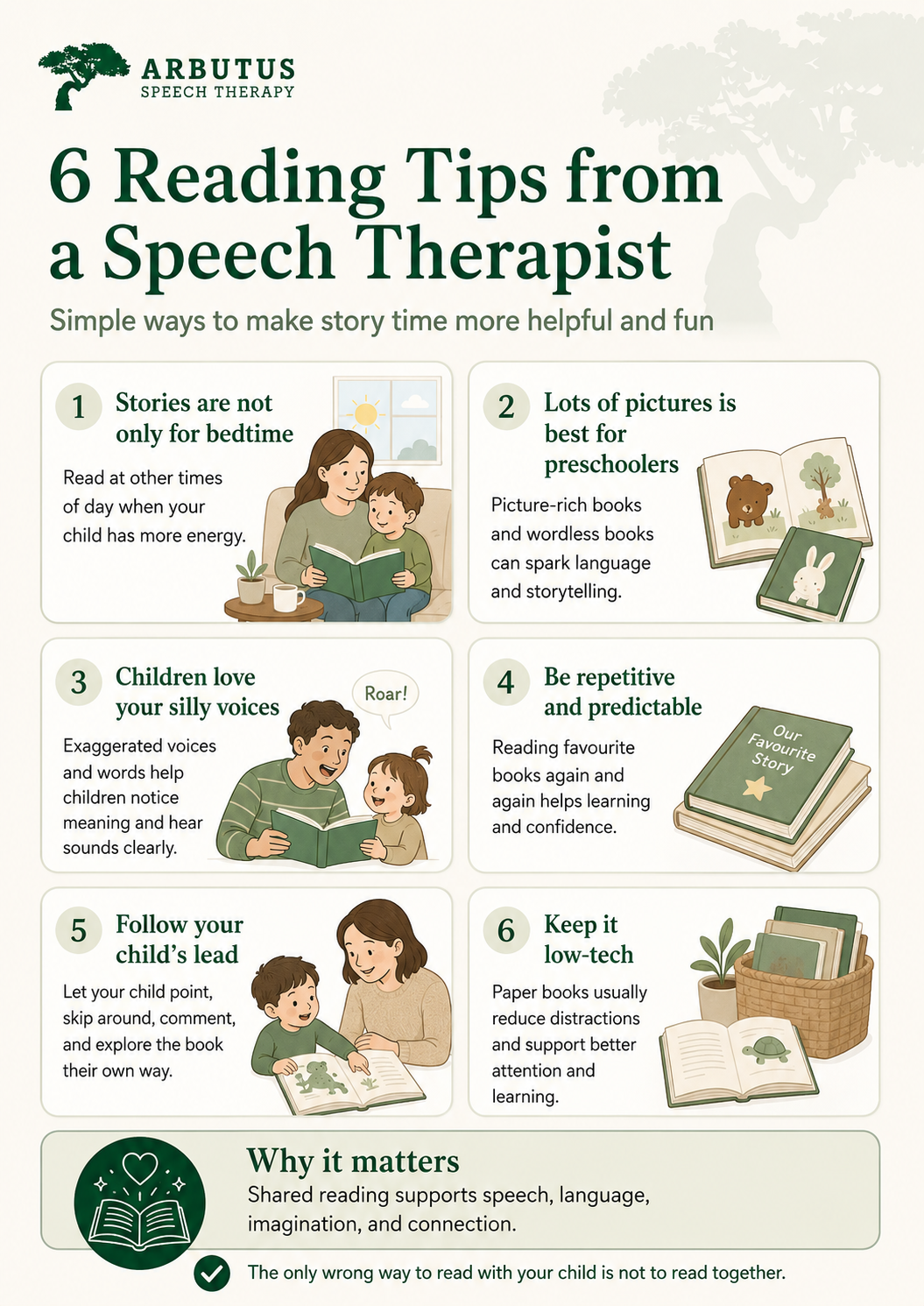
Read on for some helpful tips for reading with your children. Remember: the only wrong way to read to your children is to not read with them at all. Have fun!
1. Stories Aren’t Only for Bedtime!
Incorporate book reading into other times of the day when your child will have more energy. Try reading waterproof books together in the bath or while waiting for the bus on a rainy day!
Parent tip: Keep a few board books in your bag, the bath, or your child’s car seat. Even five minutes of reading together at an unexpected time counts.
2. Lots of Pictures is Best for Preschoolers
Young children are drawn to books with lots of pictures. You can even try a wordless picture book to see if your child can create a story of their own.
Parent tip: If your child isn’t interested in the words yet, that’s okay. Pointing to pictures and naming what you see together is language-building too.
3. Children Love Your Silly Voices
Worried you’ll feel silly reading a children’s book out loud? Don’t be! Your child will love your silly voices. Exaggerating certain words will help your child learn the meaning of words and is a wonderful way for your child to clearly hear every sound in a word.
Parent tip: If your child is working on a specific sound in speech therapy, try emphasizing that sound when it comes up in a story. Hearing it clearly and repeatedly in context is a great way to reinforce what they’re already practicing.
4. Be Repetitive, Predictable, and Repetitive
Don’t be afraid to read the same books over and over and over. Predictability and repetitiveness are very helpful for children’s learning. If you’re tired of the same old story lines, see if your toddler can fill in the gaps. He huffed and he puffed and _____________! If they know it all, tell them you want them to read it to you this time.
Parent tip: When a book becomes familiar, pause before a predictable word and wait for your child to fill it in. This simple technique builds vocabulary, listening skills, and confidence at the same time.
5. Follow Your Child’s Lead
Help your child develop a love for reading through a first love of story time. Get cozy, laugh, and let your child take the lead with book reading. Do they want to skip to the end? Fine! Do they not care to hear the story, but want to point to all the cats? Great! Make shared reading a time to nurture their desire to explore reading their own way.
Parent tip: Closing the book early or skipping pages is not a setback. What matters is that your child associates books with warmth and enjoyment. That foundation makes everything else easier.
6. Keep it Low-Tech When Reading to Your Child
Anything to avoid? Since you asked: stick to paper books or books with pages. Electronic books for children have shown to lead to less learning due to too many distractions (buttons, sounds, and pop-ups that pull attention away from the story and the conversation).
Parent tip: Paper books invite back-and-forth conversation. You can pause, point, and respond to your child naturally, which is exactly what builds language. E-readers and apps tend to take over that role for you.
Now that you have some fresh tips for reading time, read on for two of the most common speech goals that reading can help with: the R sound and prepositions. And if you’re looking for more ideas to use at home, 14 Simple Speech Therapy Tips Parents Can Use at Home is a great next read.
Trouble Saying the R Sound
If your child has difficulty pronouncing the R sound, you can bring extra attention to this sound while reading. Being able to hear the sound clearly is the first step to being able to produce it, so look for words that have R, especially at the end of words where the R tends to drop completely.
For extra practice, you can have your child repeat the word after you.
Best books to target R?
Over and Under the Pond by Kate Messner
We’re Going on a Bear Hunt by Michael Rosen
Rodney the Rat by Valerie Ann
Robert the Rose Horse by Joan Heilbroner
Harriet’s Horrible Hair Day by Daen Lesley Stewart
Trouble with Prepositions
If your child has a difficult time describing the location of items (up, over, next to, behind, etc.) books can be a fantastic way to teach and reinforce these tricky words. Once you’ve read a page, talk about what your child sees in the picture. Use the target words as often and as repeatedly as possible:
I see a cat on the fence.
There’s a squirrel running up the tree.
The boy is next to the house.
You can also pick books that specifically target prepositions. Use a favourite toy, stuffed animal, or your child’s body to act out the story and make real-life connections to preposition words:
There’s a teddy on your head!
Teddy likes sitting next to you.
Teddy wants to sit behind you!
When reading together, remember to encourage expressive language too. Ask questions like, “Where’s teddy now?”
Best books to target prepositions?
Around the House, the Fox Chased the Mouse by Rick Walton
We’re Going on a Bear Hunt by Michael Rosen
If You Were a Preposition by Nancy Loewen

Frequently Asked Questions
Want personalized reading strategies for your child?
Our Speech-Language Pathologists in Vancouver can help you make the most of reading time based on your child’s specific speech and language goals. A free phone consultation is a great first step.
Book a free phone consultationCheck out our other articles:

Enhancing Executive Function in Autistic Children: How Speech Therapy Supports Neurodivergent Skills Development
Executive function skills (such as planning, organizing, self-regulation, and working memory) are…

Speech Therapy for Multilingual Children: Tips and Benefits
Raising children in a multilingual environment is increasingly common, as many parents…

Stuttering: Tips for Helping Your Child
How can I help my child with stuttering? Parents can make a…

Understanding the Signs of Autism in Children: A Parent’s Guide
Autism Spectrum Disorder (ASD) affects communication and behavior in ways that can…

14 Simple Speech Therapy Tips Parents Can Use at Home
